Selling internationally from the UK has never been more promising, or more complicated.
Selling internationally from the UK has never been more promising, or more complicated.
Cross-border e-commerce continues to grow year on year, and UK retailers are increasingly looking beyond domestic borders to find new customers. For those ready to expand, the opportunity is clear.
But there is a catch. While most retailers have poured time and money into perfecting their outbound logistics, the reverse journey: getting products back when customers want to return them, is often an afterthought.
And in a cross-border context, that afterthought becomes an expensive problem fast.
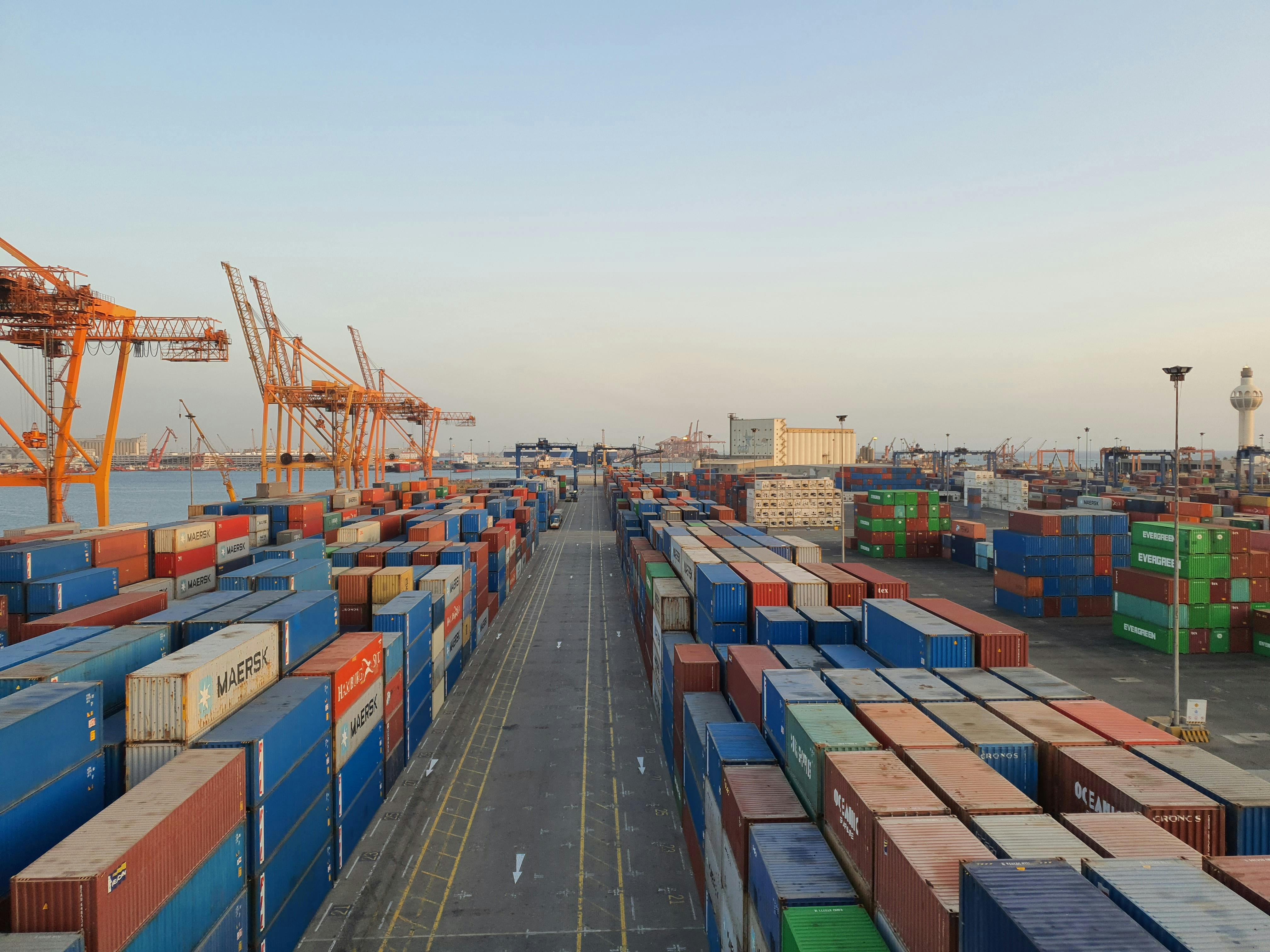
Cross-border returns involve significantly more processing steps than domestic ones.
A parcel that takes a day or two to process locally can take well over a week when it has to cross an international border, clear customs, and make its way back to a warehouse.
For UK retailers selling into Europe, the US, or further afield, that complexity is multiplied by post-Brexit trade friction, varying carrier networks, and customers who expect the same seamless experience they get when shopping domestically.
This is why getting cross-border returns right is no longer a nice-to-have.
The post-Brexit returns reality for UK Retailers
Brexit reshaped the playing field for UK retailers selling internationally, and the effects are still being felt.
UK retail exports to the EU have fallen sharply since 2019, with clothing and footwear exports hit particularly hard.
Much of this decline comes down to increased logistics costs, customs paperwork, and delays that have stretched delivery timelines considerably.
Returns amplify every one of these challenges. When a product crosses a border twice (once for the sale, once for the return) and potentially a third time for resale, retailers face multiple layers of duties, documentation, and fees.
A returned garment can end up costing more to process than it was worth in the first place.
For UK retailers, the practical headaches include customs declarations on returned goods, potential re-import duties, VAT reclamation across different jurisdictions, and the sheer time it takes to get products back into sellable inventory.
Every day a returned item sits in transit or is stuck in customs is a day of lost revenue and tied-up capital.
Our platform connects retailers to 1,500+ carrier services across 170+ countries, with routing intelligence that automatically selects the most cost-effective and efficient return path for each parcel.
Rather than trying to manage a patchwork of carrier relationships and customs processes manually, retailers can plug into a single platform that handles the complexity behind the scenes.
What international shoppers actually expect
Your international customers expect the same returns experience as your domestic ones.
Research consistently shows that UK consumers are unlikely to buy from a brand again after a poor returns experience.
That expectation does not soften just because the parcel has to cross a border.
International shoppers want clarity on costs before they buy, a straightforward process for initiating a return, and visibility on where their refund stands.
High or unclear shipping costs are one of the biggest reasons cross-border shoppers abandon their carts, and a vague returns policy only makes things worse.
If a customer in Germany or the US cannot immediately understand how to send something back and when they will get their money, they will shop elsewhere.
This is where the post-purchase experience becomes critical.
ZigZag's post-purchase platform transforms what is usually a black hole of uncertainty into a branded, proactive communication channel.
Instead of customers wondering where their return is and flooding your support inbox, ZigZag sends smart status notifications at every stage of the return journey.
The result is significantly fewer "where is my refund?" contacts, stronger repeat purchase rates, and a customer experience that feels consistent whether someone is returning from London or Lyon.
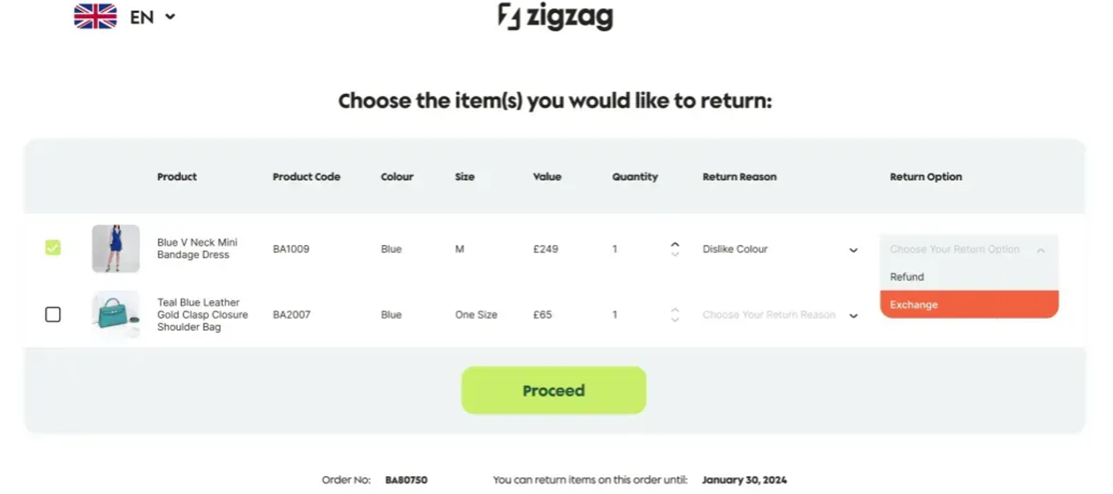
The returns portal itself supports multiple currencies and languages, which sounds basic but is surprisingly rare in practice.
An Italian customer returning a product to a UK retailer sees the portal in their language, with pricing in their currency, and gets access to local drop-off options rather than being asked to figure out international postage on their own.
Building a cross-border returns strategy that works
Getting cross-border returns right comes down to a few core principles. Here is how to approach each one.
Consolidate your carrier network instead of managing it piecemeal
The biggest mistake UK retailers make with international returns is trying to negotiate individual relationships with carriers in every market they sell to.
This creates a fragmented system that is expensive to manage and impossible to optimise.
ZigZag's carrier network spans 1,500+ services globally, meaning retailers can offer customers convenient local return options: drop-off points, collection services, even paperless returns, without having to set up each relationship from scratch.
The platform's routing engine automatically selects the best carrier for each return based on cost, speed, and the customer's location.
Meet customers on the channels they already use
One of the most significant friction points in cross-border returns is the initiation step.
Asking an international customer to log into a portal, find an order number, and navigate a process in a language that might not be their first creates drop-off.
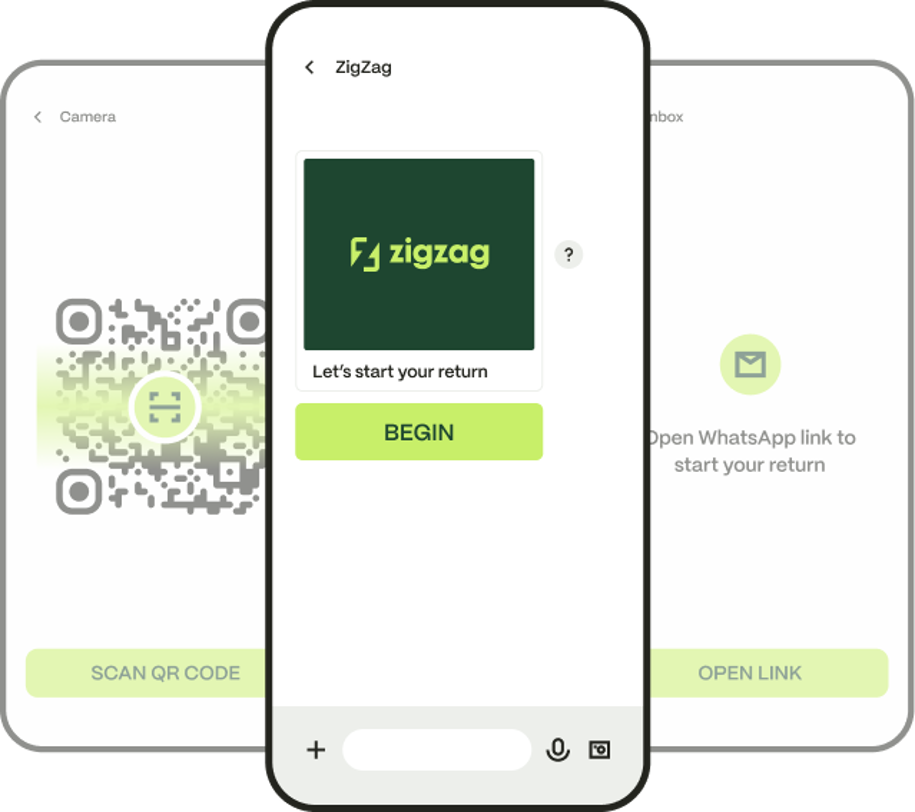
Customers scan a QR code from their packing slip or click a link from an email, and the entire return process happens inside a WhatsApp conversation.
Labels are delivered directly in the chat. Drop-off instructions are clear and localised.
For retailers offering paid returns, payment happens within the same conversation using mobile-friendly options like Apple Pay and Google Pay.
For UK retailers selling into markets where WhatsApp dominates, most of Europe, large parts of Asia and Latin America, this is not a gimmick.
It is meeting customers where they already are, on a platform they use daily, in a format that feels natural rather than transactional.
Do not let carrier billing errors eat into your margins
Cross-border shipping involves more carriers, more handoffs, and more opportunities for things to go wrong.
Late deliveries, incorrect surcharges, lost parcels, and damaged goods all represent money that retailers are entitled to claim back, but rarely do.
The process of filing carrier claims manually is time-consuming enough for domestic shipments. For international ones, it is often abandoned altogether.
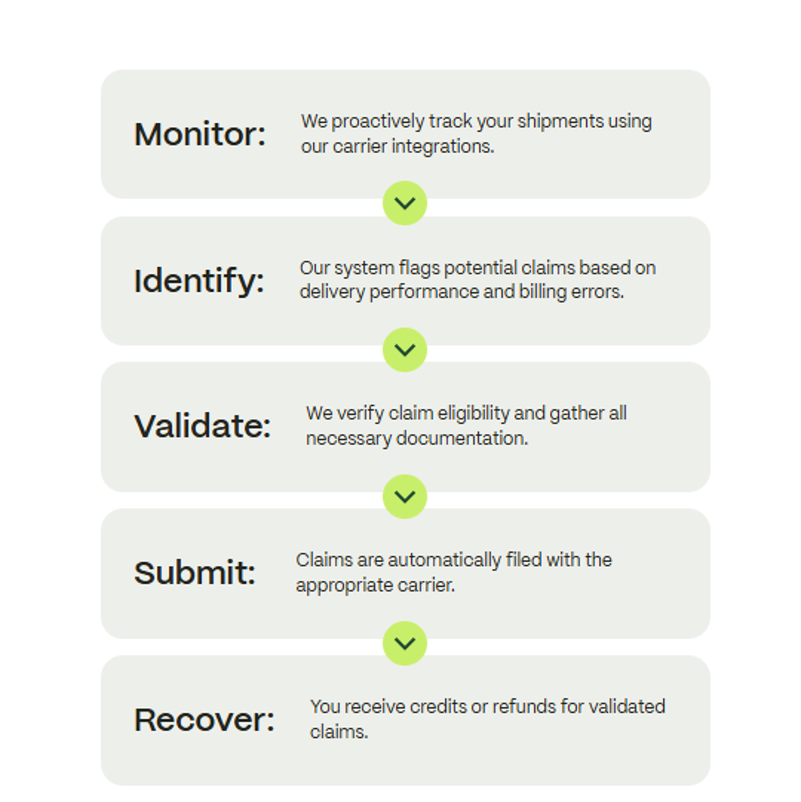
ZigZag's Automated Carrier Claims service tackles this by monitoring shipments in real time, identifying SLA breaches and billing discrepancies automatically, and filing claims on the retailer's behalf.
It covers delayed deliveries, billing errors, lost parcels, and damaged goods.
For UK retailers managing returns across multiple international carriers, this turns what was previously a resource drain into a genuine revenue recovery channel.
Invest in visibility and data, not just logistics
The retailers who handle cross-border returns well are not just the ones with the cheapest shipping rates.
They are the ones who understand why products are coming back, which markets have the highest return rates, and where the bottlenecks in their reverse logistics sit.
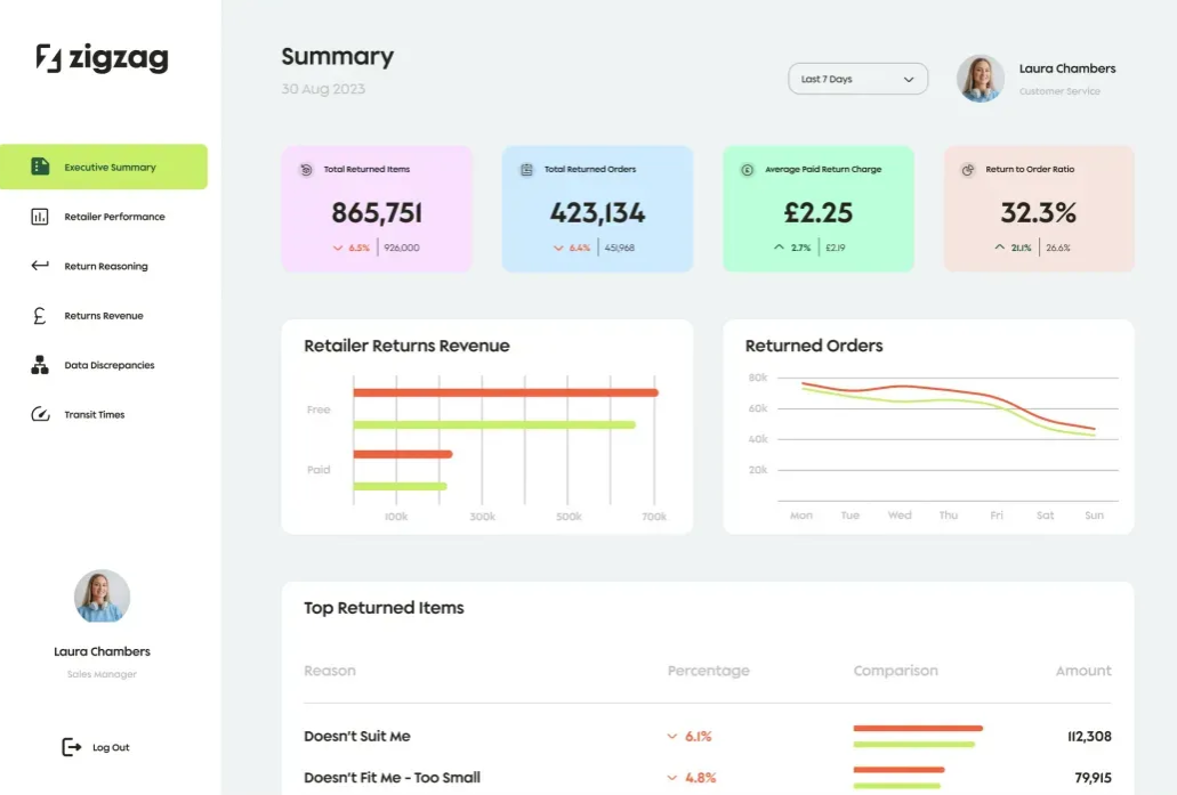
ZigZag's analytics dashboard gives retailers a single view across all their return activity, from the most common return reasons by market to refund processing times and carrier performance comparisons.
This kind of data allows retailers to move from reactive returns management to proactive decision-making, adjusting product descriptions, sizing guides, or carrier choices based on real patterns rather than guesswork.
Cross-border e-commerce is not slowing down
The global market continues to grow at pace, and UK retailers who can offer a reliable, transparent international shopping experience (including the returns experience) will capture a disproportionate share of that growth.
The retailers who get this right treat returns not as a cost centre but as an extension of the customer experience.
They offer local return options in every market they sell to.
They communicate proactively so customers are never left guessing.
They recover the money they are owed from carrier errors. And they use data to continuously improve.
ZigZag Global brings all of this together in a single platform, purpose-built for the complexity of international returns.
If you are a UK retailer selling across borders and your current returns process involves spreadsheets, manual carrier management, or customers emailing your support team to ask how to send something back, it is time to look at what a connected returns platform can do.
Book a demo to see how ZigZag can simplify your cross-border returns.
By clicking “Accept All Cookies”, you agree to the storing of cookies on your device to enhance site navigation, analyze site usage and assist in our marketing efforts. More info
By clicking “Accept All Cookies”, you agree to the storing of cookies on your device to enhance site navigation, analyze site usage and assist in our marketing efforts. More info
.svg)

.svg)
.svg)
.svg)
.svg) Returns
Returns.svg) Returns Solution
Returns Solution Returns Solutions
.svg) Rating (4.8)
Rating (4.8) Reviews400+
.svg)

 Return arrived at ZigZag Returns Hub

 Returning remaining items
.svg) Join our mailing list
Join our mailing list


.svg)





%20(5).svg)

.svg)

.svg)


.svg)
%20(2).svg)
.svg)





.svg)
.svg)
.svg)


.svg)