How Do You Convert Shopify Returns Into Exchanges Or Store Credit?
This guide covers how ZigZag's Shop Now and Shop Later convert Shopify returns into exchanges and store credit, and how bonus incentives make those options appealing.
This guide covers how ZigZag's Shop Now and Shop Later convert Shopify returns into exchanges and store credit, and how bonus incentives make those options appealing.
TL;DR
A return doesn't have to end in a refund; an exchange or store credit keeps both the customer and the revenue, and a bonus on top makes the non-refund options genuinely tempting.
ZigZag's Shop Now keeps customers shopping mid-return, letting them pick any product and spend their refund plus bonus credit on it. Shop Later swaps the refund for store credit or a gift card, also with an optional bonus.
Both are part of the ZigZag Returns and Exchanges app for Shopify, with no development work and setup in 16 minutes or less.
Why are returns such a drain on Shopify stores?
Returns drain Shopify stores because a refund reverses the whole sale: the cash goes back to the customer, and the store is left with a returned item worth less than the order plus the cost of processing it.
UK return volumes make that a frequent event. A customer who loved a product enough to buy it sends it back over a slightly off fit, and a completed sale turns back into cash out the door.
At scale, that pattern gets expensive. UK non-food online returns were forecast at £25.1bn for 2025, and clothing return rates now average 23.6% of ecommerce orders, according to ZigZag's Annual Returns Report 2025/2026.
That means, for a fashion store, close to a quarter of everything sold can come back.
The financial hit is only part of the picture. Refund speed and returns experience now shape whether someone shops with a brand again, and younger shoppers in particular walk away from restrictive policies.
That means a clumsy returns process quietly costs future orders too.
There is a more optimistic way to read those numbers, though. A shopper starting a return is still in contact with the brand and still wants something from it.
Exchanges and store credit are two ways to hold onto that moment before it turns into a refund.
What does saving the sale actually mean?
Saving the sale means holding onto revenue when a customer starts a return, by steering them towards an exchange or store credit before a cash refund goes out.
Most returns default to a refund, and a refund is the one outcome that undoes the sale completely, sending the payment back while the store absorbs the return costs.
The better move is to offer something the shopper might prefer anyway.
Take the person sending back a jumper because it was too small: more often than not they still want the jumper, just in a medium, so a quick swap settles it.
Others are less sure, but give them an easy way to browse the rest of the range, and plenty will find a replacement they like.
Store credit catches the rest, particularly when there's a small sweetener for choosing it over cash.
Two features in the ZigZag Returns and Exchanges app for Shopify are built around this: Shop Now and Shop Later.
How does Shop Now turn a return into another sale?
Shop Now keeps the customer inside your store during the return, so a refund request can become a fresh order before any money goes back.
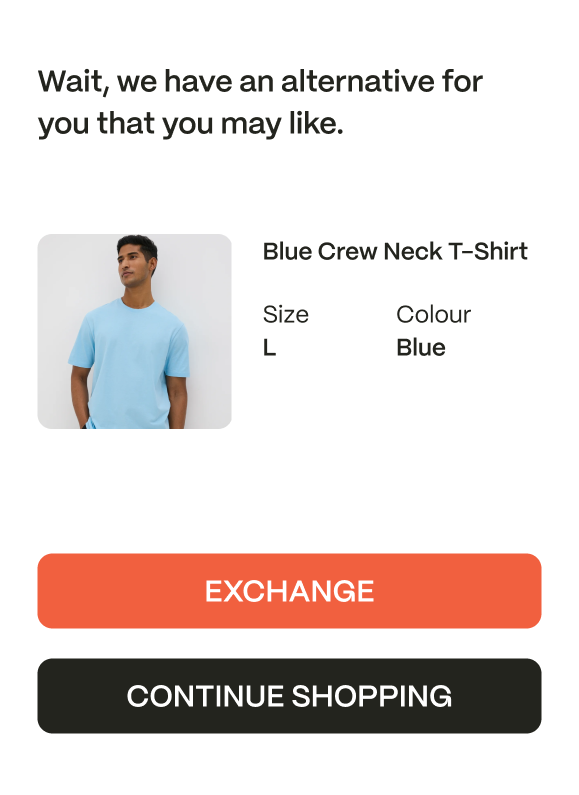
When someone starts a return, it invites them to browse your catalogue and put their refund towards something new, whether that is the same item in another size or a completely different product they spot along the way.
They can search by name or SKU, or open your storefront and browse as normal, then carry their selection back into the returns portal to finish up.
You can surface the offer early, as soon as they choose a return option, and again on the final summary page, often with a slightly stronger bonus the second time to win back a sale about to slip into a refund.
How does the bonus credit work?
The pull behind Shop Now is bonus credit, a little extra spending power added on top of the refund to make shopping again the easy choice.
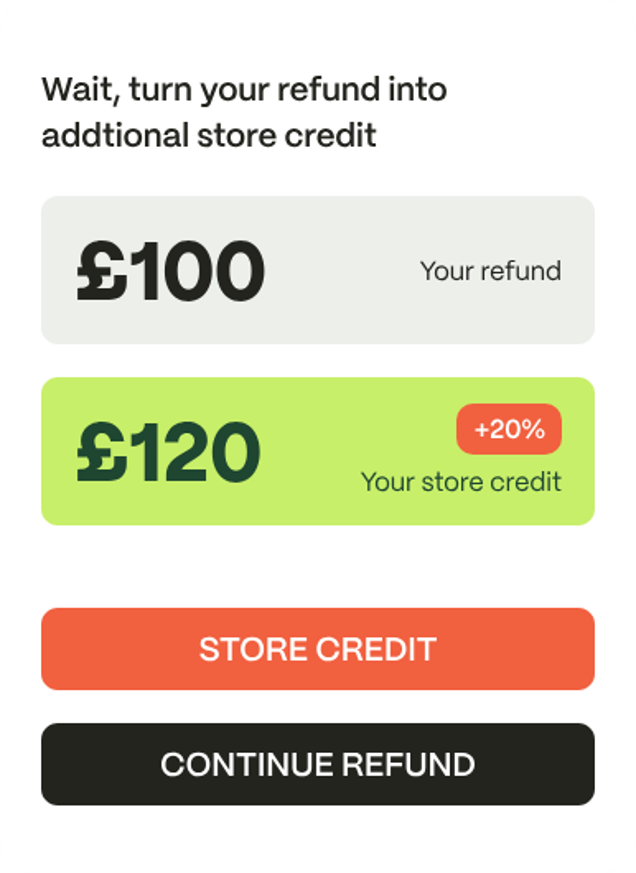
You decide how it is worked out, whether that is a flat sum, a percentage of the refund, or a mix of the two, so a £100 refund might land as £120 to spend in your store.
The bonus only comes into play once the customer spends beyond their original refund value, so it works as a real nudge towards a slightly bigger basket, not free money handed out on every return.
You can also set a minimum refund value before Shop Now appears at all. Put the floor at £50, and a £49 return will pass it by, which keeps the incentive for the orders where offering one actually pays off.
What happens when the new order costs more?
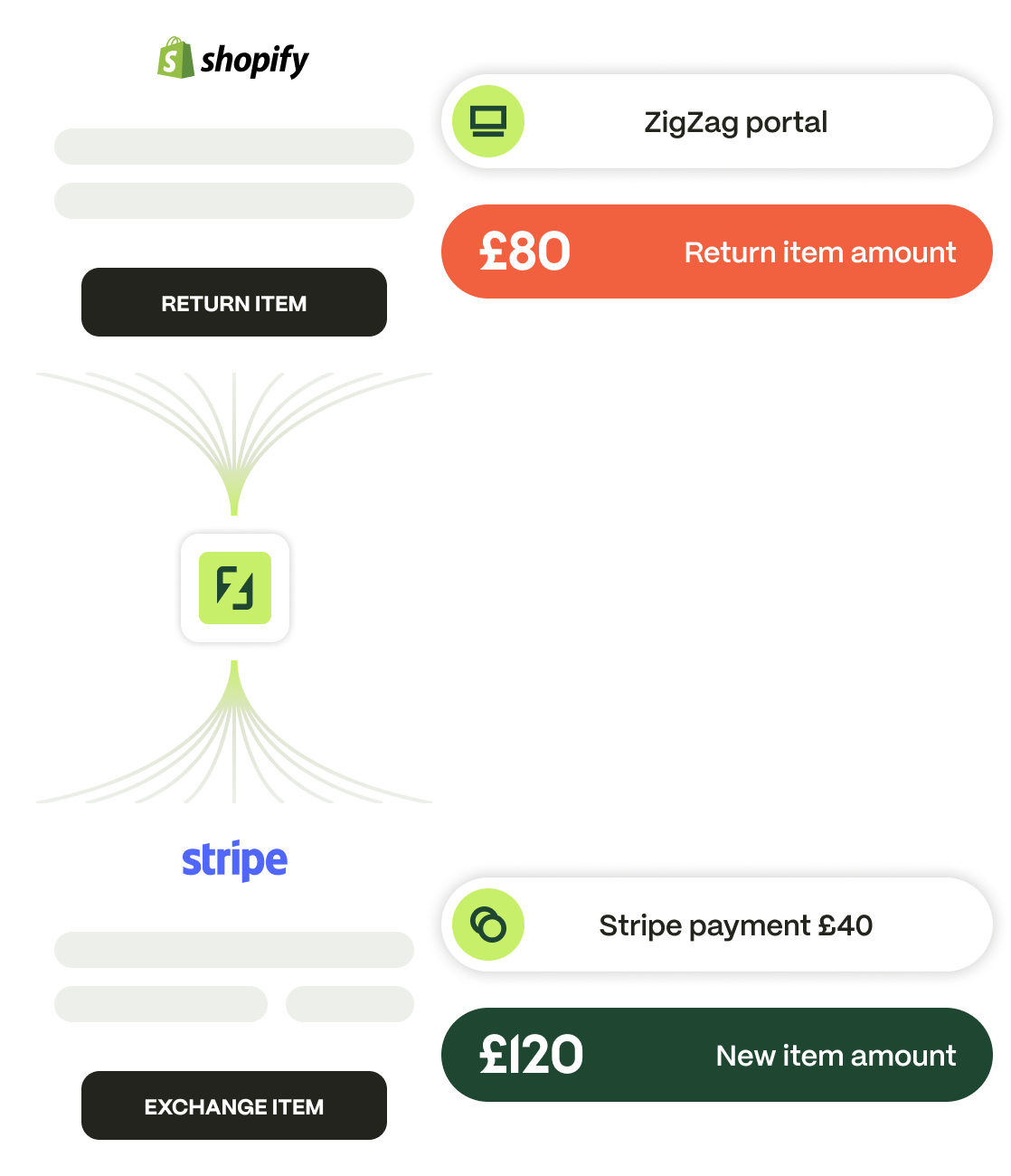
When the customer picks something worth more than their refund and bonus combined, ZigZag's Stripe integration collects the difference inside the returns portal, so there is no separate invoice to chase afterwards.
The payment is only taken once you approve the return, and it is released back to the customer if you reject it, so nobody is charged for a return that never goes ahead.
References stay tied to the original order throughout, which keeps the figures easy to reconcile later.
How does Shop Later work with store credit?
Shop Later swaps a refund for store credit or a gift card, so the value stays with your brand until the customer is ready to spend it.
It suits shoppers who do not want to choose a replacement in the moment but would happily shop with you again later.
The two options work a little differently.
Store credit is a native Shopify feature that issues a balance straight to the shopper's customer account, functioning as a digital wallet they can spend on a future purchase, and it needs Shopify's new customer accounts enabled first.
The gift card option is a discount code the app generates and sends to the customer when the return is processed.
Either way, the money stays in your store.
As with Shop Now, you can add a bonus to make the offer land better, turning a £100 refund into, say, £120 of credit.
A minimum refund value stops that bonus from applying to very small returns, so a generous top-up never dwarfs the amount being returned.
The customer sees a perk worth taking, and you hold onto value that a straight refund would have handed back.
What makes this easy to run on a Shopify store?
Both features are set up with business rules and toggles and need no code, which is what keeps them easy to run.
Powerful returns logic only helps when the team can switch it on without waiting for developers.
Setting up Shop Now is about as involved as writing an email subject line.
You set your business rules, line them up with your returns policy, flip the feature on, and it's live.
In fact, most merchants are up and running in 16 minutes or less.
Reporting stays clean too.
The app tracks the value of exchanged and returned items with clear references across your systems, so you can see retained revenue without your reports turning into a puzzle.
How do you decide between exchange, store credit, and refund?
How you decide depends on the store, because no single policy fits every catalogue, but a few principles hold up well.
Exchanges deserve top billing whenever fit or variant is the reason for the return, since that is the quickest route to a customer who stays happy.
Sizing is still the number one reason fashion comes back, so a clean size swap clears a large chunk of returns by itself.
Store credit works best as a middle option, appealing enough that shoppers actually weigh it up, though the extra should stay inside limits that protect your margin.
Alongside both, the straightforward cash refund needs to stay on the table. Nudging customers away from it too hard tends to dent trust and cost you loyalty down the line.
Return windows and rules are yours to shape around real behaviour.
Nobody knows your customers and your stock better than you do, so let the policy follow how they actually shop, not some default setting.
Ready to turn returns into repeat sales?
Shop Now and Shop Later give your Shopify store a way to keep customers and revenue when a return begins, whether that means a quick size swap or store credit a shopper comes back to spend.
To see how the flow would look against your own returns policy, you can book a ZigZag demo and walk through it with the team.
Frequently asked questions
Can customers pay the difference on a higher-value exchange?
Yes. Through the Stripe integration in ZigZag's Shopify app, shoppers pay the difference inside the returns portal when they choose something more expensive, and the amount is only taken once you approve the return, with clear references tying it to the original order.
Does offering store credit mean refusing refunds?
No. Store credit through Shop Later is presented alongside the refund, usually with a little extra value to make it worthwhile.
Customers who want their money back can still have it.
Do I need a developer to set this up?
No. Shop Now and Shop Later are configured with business rules and toggles, with no coding required. ZigZag reports that most stores are live in 16 minutes or less.
Will this work for cross-border returns?
Yes. Shop Now works for international shoppers once international exchanges are switched on, and the app converts your bonus and minimum-refund values into the customer's local currency automatically, so the numbers stay accurate wherever they shop.
By clicking “Accept All Cookies”, you agree to the storing of cookies on your device to enhance site navigation, analyze site usage and assist in our marketing efforts. More info
By clicking “Accept All Cookies”, you agree to the storing of cookies on your device to enhance site navigation, analyze site usage and assist in our marketing efforts. More info
.svg)

.svg)
.svg)
.svg)
.svg) Returns
Returns.svg) Returns Solution
Returns Solution Returns Solutions
.svg) Rating (4.8)
Rating (4.8) Reviews400+
.svg)

 Return arrived at ZigZag Returns Hub

 Returning remaining items
.svg) Join our mailing list
Join our mailing list


.svg)





%20(5).svg)

.svg)

.svg)


.svg)
%20(2).svg)
.svg)





.svg)
.svg)
.svg)


.svg)