What Is Shop Now, Shop Later, and How Are They Different From Exchanges?
This guide covers what Shop Now and Shop Later actually do inside a return and how each one differs from a standard exchange, so you can work out which combination keeps the most revenue in your business.
This guide covers what Shop Now and Shop Later actually do inside a return and how each one differs from a standard exchange, so you can work out which combination keeps the most revenue in your business.
TL;DR
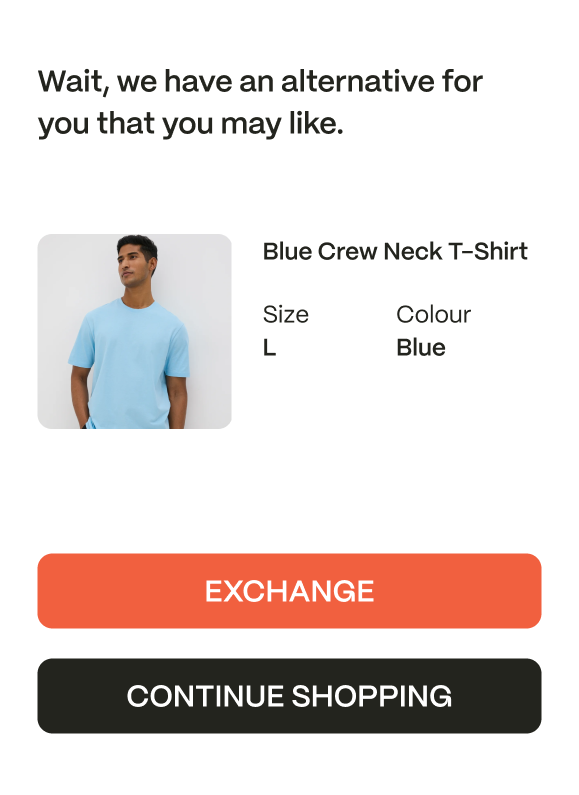
An exchange is for a customer who wants a different item. It can be a simple variant swap, like a new size or colour, or a switch to a completely different product, with the customer paying the difference if the replacement costs more.
Shop Now steps in when a customer is heading for a cash refund, offering their refund value with a bonus on top to spend in your store during the return itself.
Shop Later suits customers who want their money back but are not ready to buy yet. They take store credit or a gift card-style code, often topped up with a bonus, to spend when it suits them.
The dividing line: an exchange is something the customer asks for, while Shop Now and Shop Later are nudges you set up to keep a refund from leaving. All are ZigZag Save the Sale features on Shopify.
What's the difference between an exchange, Shop Now, and Shop Later?
All three keep a would-be refund inside the business, but they do it for different customers at different moments.
Let’s go over one by one:
How far can a standard exchange go?
Most shoppers already understand the exchange: they send an item back and receive a replacement, with no cash refund involved.
At its simplest, this is a variant swap, the same product in a different size or colour, with no money changing hands beyond the original order.
ZigZag also lets customers exchange for a different product entirely, searching your catalogue or browsing your storefront and picking any item as their replacement.
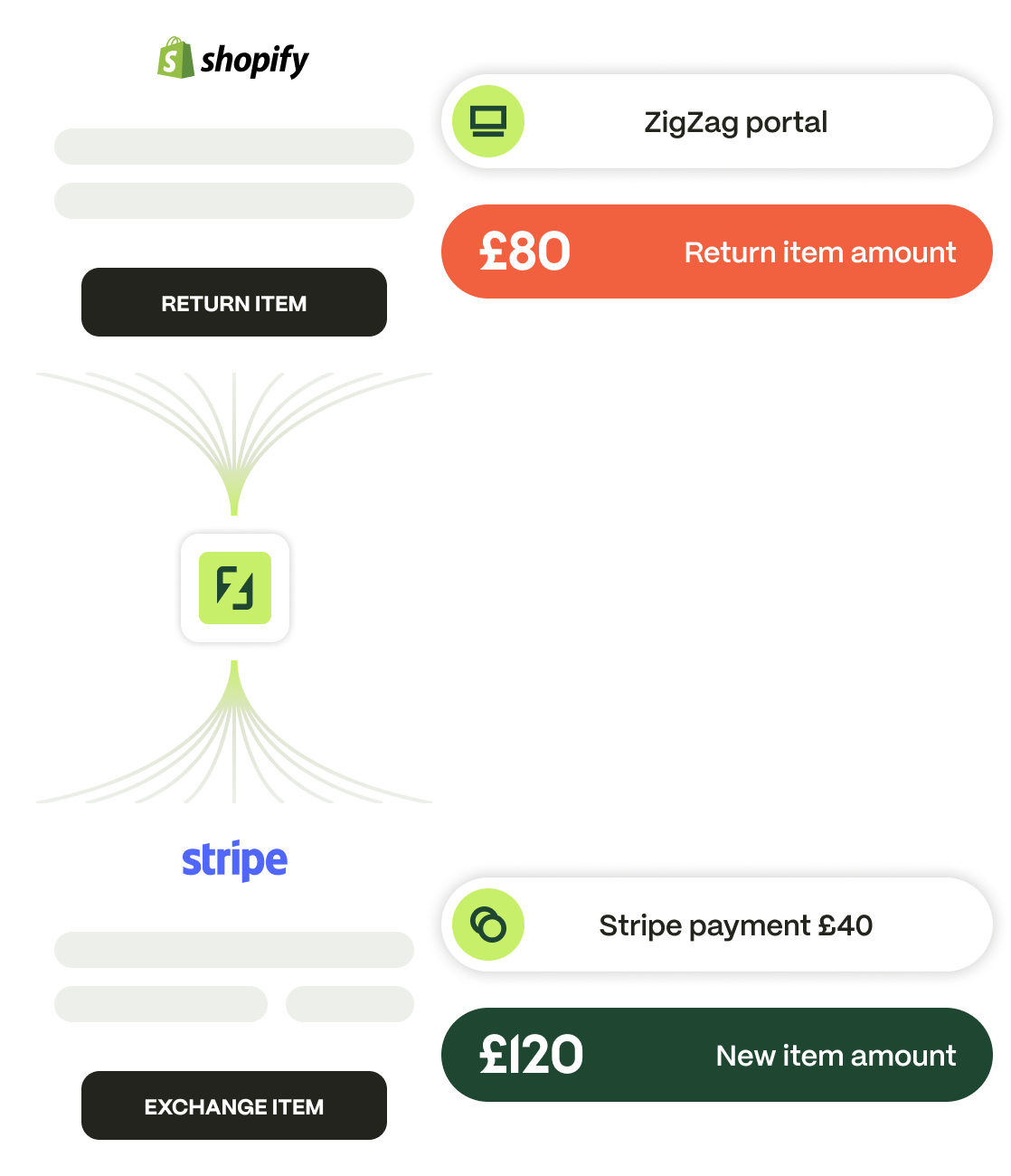
If that item costs more than the one they returned, the difference is settled during the return through the Stripe integration (more on that shortly).
If it costs less, the leftover balance stays in play for the next step.
The key point is that an exchange is customer-led. The shopper has already decided they want a different item, and the feature simply makes the swap easy. That is what separates it from the two features that follow.
What is Shop Now, and how does it catch a refund?
Shop Now is aimed at a different customer: the one about to take their money back.
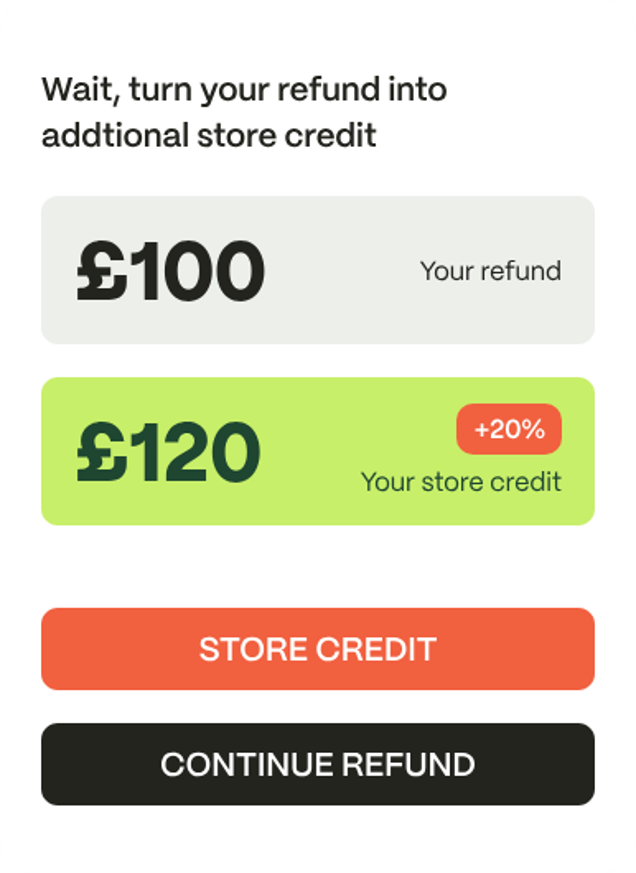
It appears at the moment a refund is on the table, either as soon as the return option is chosen or later on the summary page, and offers the shopper their refund value with a bonus added to spend in your store there and then.
That bonus is the whole point.
Say a customer is due a £100 refund. With a £20 Shop Now bonus configured, they see £120 of credit to spend, browse your store, and put it toward whatever they like.
If they pick something dearer, they pay the difference through the returns portal, and when Stripe is connected, that happens in the same checkout with no separate invoice.
The chosen items are processed as an exchange, but the shopper experiences it as a shopping trip funded by the refund they were about to pocket.
The bonus can be a flat amount or a percentage of the refund, and you can set a minimum refund value so it only shows when the numbers justify it.
You can also run a gentler offer early in the flow and a stronger one on the summary page as a final attempt to save the sale.
One thing to note: any bonus the customer does not use simply expires when the return is submitted, so it never becomes a payout.
When would a customer choose Shop Later?
The last option, Shop Later, suits the shopper who wants their money back but is not ready to spend it today.
In place of a cash refund, they take store credit or a gift-card-style code, and, as with Shop Now, you can sweeten it with a bonus so the credit is worth more than the cash would have been.
The two options behave slightly differently.
Store credit lands as a balance on the customer's account, ready to use like a digital wallet next time they visit.
The gift-card option arrives as a discount code by email.
Either way, the money stays with you, the customer has a reason to come back, and the bonus is what makes the credit worth taking.
How do Exchanges, Shop Now, and Shop Later compare?
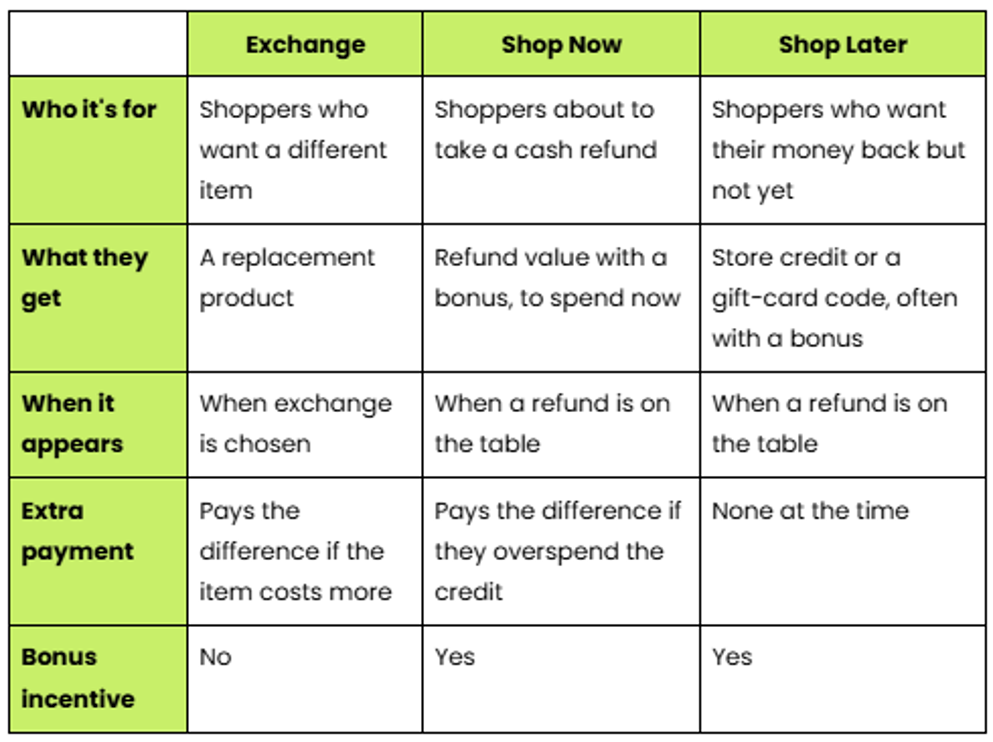
Side by side, the differences are easier to see:
Each option gives the customer a reason to keep their money with you when a refund would otherwise take it out.
An exchange does this for people who already want a swap.
Shop Now goes after the refund itself, using a bonus to turn it into an immediate purchase.
Shop Later covers the ones who are not ready to buy, parking their money as credit until they are.
Most retailers switch on more than one, so there is a fitting option at whichever point a customer might otherwise cash out.
How much work is it to switch on?
Less than the payment mechanics might suggest, because it is configuration, not code.
You set your rules to match your existing returns policy and switch on the features you want in the app.
There are also a couple of Shopify pieces to enable behind the scenes, such as the theme app embed that links the returns portal to your storefront for Shop Now.
Connecting Stripe for balance collection runs through Stripe's own hosted onboarding, so there is nothing to build.
We’d put the typical go-live at around 16 minutes once the groundwork is in place.
Reporting stays readable too.
Exchanged and returned items carry clear references, and Shop Now bonuses show up as a proportional discount across the selected items, so retained revenue is easy to follow without unpicking your figures afterwards.
Ready to keep more sales inside the business?
Refunds are never disappearing altogether, but they do not have to be the default ending to a return.
If you would like to see how Shop Now and Shop Later would work within your own returns flow, you can book a demo with ZigZag and the team will walk you through it.
FAQs
Is Shop Now just an exchange with a bonus attached?
Mechanically they overlap, since Shop Now items are processed as exchange items.
The difference is intent and timing.
An exchange serves a customer who already wants a swap, while Shop Now appears specifically when a refund is on the table and uses bonus credit to change the shopper's mind.
What is the difference between the store credit and gift card options in Shop Later?
Store credit is a balance on the customer's account that works like a digital wallet on their next visit.
The gift card option is a discount code sent by email. Both keep the money with you and can carry a bonus.
Do I need all three, or just one?
Many retailers run a mix:
Exchanges cover the straightforward swaps.
Shop Now is the one to reach for when a customer is about to take cash back.
Shop Later catches those who want their refund now but might come back to spend it.
By clicking “Accept All Cookies”, you agree to the storing of cookies on your device to enhance site navigation, analyze site usage and assist in our marketing efforts. More info
By clicking “Accept All Cookies”, you agree to the storing of cookies on your device to enhance site navigation, analyze site usage and assist in our marketing efforts. More info
.svg)

.svg)
.svg)
.svg)
.svg) Returns
Returns.svg) Returns Solution
Returns Solution Returns Solutions
.svg) Rating (4.8)
Rating (4.8) Reviews400+
.svg)

 Return arrived at ZigZag Returns Hub

 Returning remaining items
.svg) Join our mailing list
Join our mailing list


.svg)





%20(5).svg)

.svg)

.svg)


.svg)
%20(2).svg)
.svg)





.svg)
.svg)
.svg)


.svg)