Taking time off to receive a package, turning the living room into a fitting room, and making purchases with the intention of returning them: e-commerce is no longer just changing how the French shop. It is reorganising their daily lives.
In 2026, returns are no longer an exception at the end of the customer journey. They influence brand choice, purchasing decisions, order profitability, and future loyalty.
This shift is particularly evident among younger consumers. According to a 2026 study conducted by Sapio Research for ZigZag, 44% of Gen Z members say they have already adopted at least one planned buy-and-return behaviour, compared to only 9% of Baby Boomers. For this generation, ordering, trying on at home, and then returning is no longer a glitch in the process: it is the process.
Retailers must therefore adapt to a dual reality: consumers who are more comfortable with returns, but also much more demanding when faced with delivery friction, opaque policies, and slow refunds.
Source: study conducted in May 2026 by Sapio Research for ZigZag among 2,000 French consumers.
The traditional e-commerce model was based on a simple distinction: the consumer chose a product, bought it, and only returned it if there was a problem.
This logic no longer fully aligns with current behaviours.
In apparel, 18% of items purchased online are returned on average. The rate reaches 14% for footwear, 12% for electronics, and 11% for health and beauty products.
Some of these returns are still linked to classic reasons: wrong size, poor fit, or a discrepancy between the online presentation and the product received. However, returns are also now integrated into the purchasing decision from the start.

Among consumers who return non-food products:
These are not isolated incidents. For many shoppers, the home has become a fitting room: consumers order multiple options, compare products at home, and keep only their preferred choice.
The generational divide is clear.
On average, 46% of Gen Z retail purchases are made online, compared to 45% for Millennials, 40% for Gen X, and 31% for Baby Boomers.
This trend is consistent with INSEE data: in France, 79% of people aged 15 to 44 have made an online purchase, compared to 49% of those aged 60-74.
But the difference isn't just about purchase frequency. It primarily concerns the very concept of returns.
44% of Gen Z consumers have already adopted at least one planned buy-to-return practice, such as:
Among Baby Boomers, only 9% report having adopted at least one of these behaviours.
What this changes
Retailers cannot simply identify "bad returns" after they arrive at the warehouse. They must act earlier by distinguishing between three categories:
A uniform policy treats all consumers the same way. It is simple to administer, but rarely optimal for margins or the customer experience.
Returns are a moment of truth. Yet only 21% of French consumers describe their return experiences over the last twelve months as consistently simple, seamless, and reliable. [Data from the ZigZag 2026 study]
This weakness has an immediate commercial impact: 72% of respondents state that a poor return experience makes them less likely to buy from the same brand again.
Returns should therefore no longer be evaluated solely by their logistical cost. They also affect:
A retailer can succeed in acquisition, conversion, and delivery, only to lose the customer for good at the return stage.
Consumers don't wait until they receive their order to judge the return experience. They evaluate it before they pay.
According to the study:
The return policy is therefore a key component of the product page and checkout, just like price, delivery times, or shipping options.

Sportswear brand Odlo clearly highlights its 30-day free return policy.
Vague phrasing like "returns possible under certain conditions" forces the consumer to hunt for information or accept a risk. Instead, retailers should clearly present:
Transparency doesn't just reduce support requests. It can also prevent cart abandonment.
Consumers remain highly sensitive to return costs. 54% state that paying fees is the primary factor that would discourage them from returning a product.
However, this does not mean that all returns must remain free without conditions.

When faced with a paid model, respondents prefer a moderate flat fee of around €2.50 covering the entire order, rather than a charge applied to each returned item.
The right answer depends on the context. Retailers can, for example, offer:
The goal is not to make returns complicated. A punitive policy risks lowering conversion rates. Instead, it is about offering multiple options, displaying their costs, and guiding consumers toward the most efficient paths.
Once the product is dropped off, the consumer does not consider the return process finished. They are waiting for their refund.
The study reveals two thresholds:
To reduce this wait time, retailers should track the following separately:
Without this breakdown, a total turnaround time of twelve days makes it impossible to identify whether the issue lies with the consumer, the carrier, the warehouse, or the financial process.
Returns are only part of the problem. Even before deciding whether to keep or return a product, consumers have to successfully receive it.
One in three French people has taken time off work, changed their work schedule, or reorganised their day to wait for a delivery. Those affected spend an average of 3.8 hours waiting for their packages, and this situation impacts about 9% of their orders.
More concerningly, among consumers who have waited for a delivery, 87% report that at least one package arrived outside the scheduled window or did not arrive at all.

The issue goes beyond mere convenience. An inaccurate estimate can lead to:
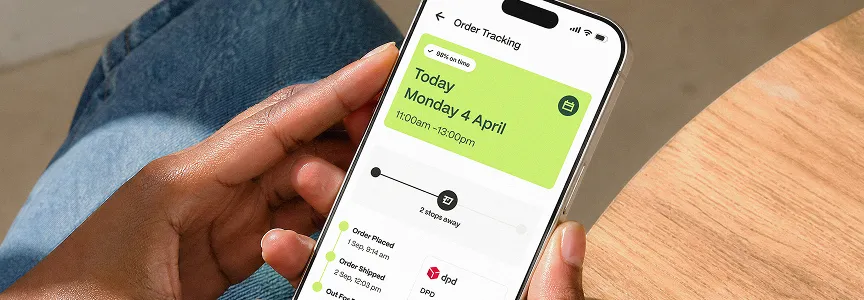
The delivery promise should no longer be a generic window calculated at checkout. It must be updated after shipment based on real-time carrier events.
22% of French consumers have experienced at least one package theft in the last twelve months.
Among the victims, 91% subsequently changed at least one habit:
Choosing a carrier and delivery method is therefore not just an operational decision. It influences trust, conversion, and the likelihood of a customer ordering again.
Retailers must, in particular, allow consumers to choose between several solutions, communicate proactively, and make incidents visible before a ticket is even opened.
These behaviours are taking place in a mature market.
In 2025, French e-commerce generated €196.4 billion in revenue, an increase of 7% over one year. Product sales grew by 4%, while services rose by 9%.
Every increase in volume mechanically increases:
Retailers who lack a unified view of delivery and returns therefore risk seeing their costs rise faster than their sales.
Unnecessary returns represent more than just a transport cost. They lead to additional operations for collection, inspection, repackaging, storage, and sometimes destruction.
At the European level, textile consumption is the fourth-largest category of consumption with the greatest impact on the environment and climate, behind food, housing, and mobility.

The European Union generates approximately 12.6 million tonnes of textile waste each year. Clothing and footwear alone account for 5.2 million tonnes, or about 12 kg per person, while less than 1% of global textiles are recycled into new products.
In February 2026, the European Commission also adopted new measures to prevent the destruction of unsold clothing, accessories, and footwear.
The conclusion is clear: a returned product must be put back into circulation as quickly as possible. The longer it remains out of stock, the more its commercial value is likely to decline.
The numbers argue neither for eliminating returns nor for making them systematically free. They demand more precise management.
Product data must address root causes upstream: consistent sizing, detailed measurements, realistic photos, customer reviews, and fit information.
A return due to a defect, a size exchange, and repeat "buy-wear-return" behaviour should not necessarily trigger the same rules.
The timeframe, cost, and return options must be visible without extra searching.
Drop-off points, lockers, in-store, home collection, exchanges, or store credit: the process must be tailored to the order, the country, and the reason.
Four days is a target for customer experience. Sixteen days is a threshold that should not be crossed.
A late, damaged, or stolen delivery can trigger a return. Handling these steps in separate tools prevents understanding the real causes.
The return rate is not enough. Retailers must also track the time to restock, the exchange rate, the share of refunds converted into store credit, and the value lost on non-resalable products.
In 2026, French consumers expect more than just a functional return label. They want to know when their package will arrive, understand the policies before they buy, choose a convenient option, and get their money back quickly.
At the same time, a new generation views buying, trying on, and returning items as standard steps in a single experience.
Retailers cannot stop this transformation. They can, however, decide whether to be shaped by it or to lead it.
Brands that can reduce avoidable returns, detect costly behaviours, offer transparent policies, and get products back into circulation quickly will better protect their margins. They will also provide a more reliable experience for their customers.
In 2026, a sale no longer ends at checkout. Its profitability and ability to build loyalty are determined through delivery, returns, and refunds.
Statistics explicitly cited as coming from the ZigZag study are based on an online survey conducted by Sapio Research in May 2026 among 2,000 French consumers who shop online.